

A data lake is a single location for storing massive quantities of raw, unprocessed data. While it can provide flexible, scalable and cost-effective storage for an organization’s insights, it needs a robust hardware infrastructure to do so. The right hardware components will make the data lake easier to control, more scalable and higher-performing in the long run.
This article will break down everything security integrators and distributors need to build a powerful hardware infrastructure for a data lake, from storage and processing requirements to size guidelines and implementation best practices.
Core Hardware Components for Data Lakes
Explore the main data lake hardware requirements and different options you can consider for your integration project below.
Storage Infrastructure
When it comes to storage hardware for data lakes, you’ll decide between object storage and network-attached storage (NAS) options. Key considerations include:
- Scalability and cost: While object storage offers virtually unlimited scalability at a low cost, NAS options tend to be complex to scale and come at a higher price.
- Workload suitability: Object storage is best suited for large, unstructured files, like storing raw data, backups and archives. NAS is ideal for transactional or structured data and applications that need low-latency access to frequently changing data, like datasets.
- Performance: When choosing storage for your data lake, choose a system that delivers high throughput to move and process large files and data streams more efficiently. You can also consider input/output operations per second (IOPS) for smaller-scale workloads within your data lake architecture, like those hosted on a NAS.
Data Processing and Computing
While storage holds the raw data, your compute resources turn that potential into performance. These include your chosen central processing unit (CPU), graphics processing unit (GPU) and random access memory (RAM).
Choosing the right components for your data lake infrastructure requirements is essential for everything from loading data to running complex analytical queries. Learn about each option here:
- CPU: For data lake workloads, you’ll need servers with a high CPU core count. The more cores you have, the greater parallel processing, which is essential for loading multiple data streams at once and handling queries across large datasets.
- GPU: While CPUs handle the bulk of general processing, you might plan for GPU acceleration if your project roadmap includes machine learning (ML) or artificial intelligence (AI) workloads. GPUs are made for handling complex mathematical operations when training ML models, turning a process that could take days on a CPU into one that takes hours.
- RAM: RAM is the high-speed workspace for your processors. Without enough memory, you can have trouble handling queries. A good starting point is making sure there’s enough RAM to fit the datasets accessed most frequently in memory. This will speed up analytics exponentially.
Networking Essentials
Your data lake is a distributed system, and the network is the vital connective tissue between your storage and compute nodes. Standard office networking often falls short for this task as it can’t handle the bandwidth demands of moving terabytes of data. Consider the following for your integration project:
- Bandwidth requirements: For smooth data flow, build your network architecture on a foundation of high-speed connectivity. At a minimum, plan for a 10 Gigabit Ethernet (GbE) network fabric. For larger or more performance-intensive applications, you might go for 25GbE or 100GbE to keep data storage and processing running smoothly.
- Network architecture: A scalable network design, like a leaf-spine architecture, is often ideal for data lakes. This model gives you more predictable, low-latency performance so you can add more storage or compute nodes to the network without creating bottlenecks or completely redesigning the infrastructure.
Sizing Guidelines by Scale
Effective sizing is more than considering your current data volume — it’s about planning for the future. Before choosing components, plan your capacity. You can do this by calculating the organization’s projected data growth rate and establishing a data life cycle policy.
For instance, you might have it automatically move aging data to lower-cost storage tiers after a certain number of years. This way, each stage influences the hardware needed.
With that in mind, here are some common hardware starting points based on scale.
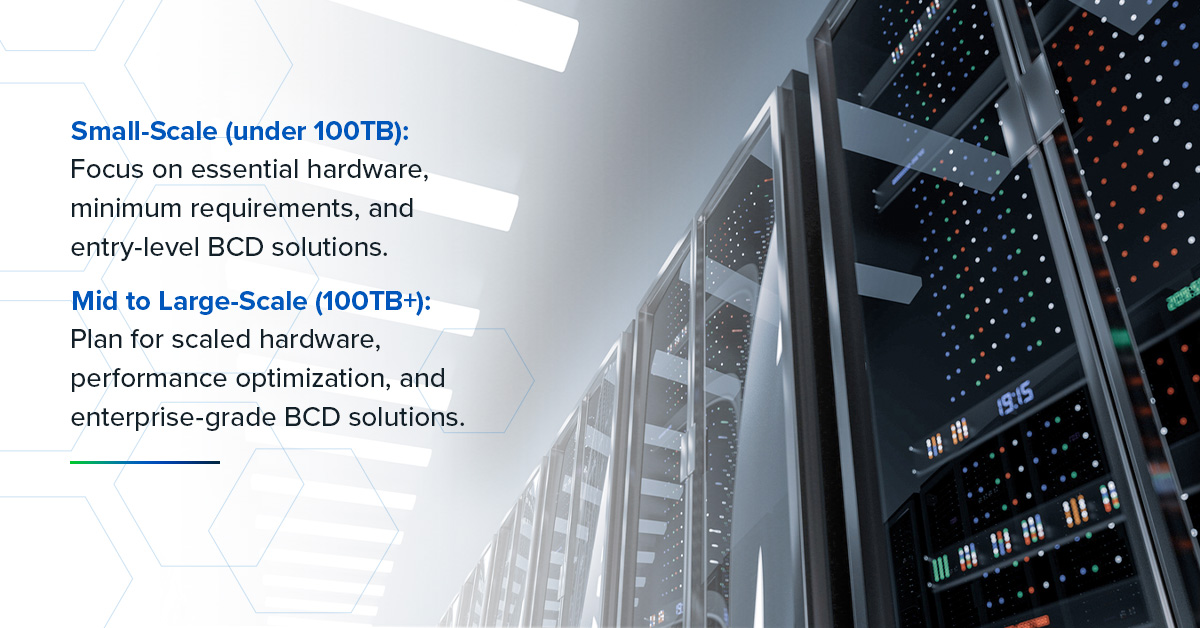
Small-Scale Data Lakes (Under 100TB)
When you’re first deploying your data lake or have a smaller-scale project, the most cost-effective approach is usually one that combines storage and compute in a single chassis. Doing this will simplify management and reduce your initial hardware footprint.
Create a server with:
- A hybrid storage model: Combine high-capacity hard disk drives (HDDs) for cost-effective bulk data storage with a smaller tier of high-speed solid state drives (SSDs). The SSDs run the operating system and cache frequently accessed data, keeping the entire system fast and responsive.
- Sufficient processing power: To handle analytics workloads, choose a balance of multi-core CPUs and at least 128 to 256 gigabytes of RAM.
- High-speed networking: Consider dual 10GbE network ports as a minimum requirement to prevent data bottlenecks.
Mid- to Large-Scale Data Lakes (100TB+)
As the organization’s data volume grows beyond 100TB, you should shift your architecture to a disaggregated model with separate, dedicated clusters for storage and compute. This way, you can scale each resource independently, which will be more efficient and cost-effective in the long run.
At this scale, you’ll be managing fleets of servers. Make sure your storage nodes can keep up with the right density and throughput, and that your compute nodes have high core counts and enough RAM.
Horizontal scaling also becomes important for mid to large-scale data lakes. You’ll often achieve better throughput and lower total cost of ownership with more mid-range nodes instead of one large chassis.
Implementation Best Practices
Follow these best practices to successfully implement a data lake:
Balancing Performance, Capacity and Cost
A successful data lake balances performance, capacity and cost. The goal is to invest strategically in the areas that will have the most impact on specific workloads.
For instance, if the primary use case is archiving and occasional reporting, prioritize storage throughput and capacity over raw CPU power. On the other hand, if your data lake will be used for intensive, real-time analytics, you might invest in faster compute nodes and more RAM for better results.
Future-Proofing Your Data Lake Hardware
As an organization’s data grows, so will its analytics needs. It’s a great idea to design the infrastructure for future growth from the start. That way, you can avoid costly rip-and-replace cycles.
To do this, choose modular hardware that can be easily upgraded. For instance, you might select a server chassis with open drive bays that allow you to add storage. Or, you could choose one with available PCIe expansion slots to add GPUs for faster network cards later.
Overall, ensure that your network fabric has enough excess capacity to handle future storage demands and compute expansion.
Build Your Data Lake on BCD Hardware
Building a high-performance data lake calls for more than just components — it requires a purpose-built infrastructure. At BCD, we specialize in configuring hardware and software for security integrators and implementation partners who manage the world’s most demanding data workloads.
We back solutions with white-glove, on-site and remote professional services and 24/7/365 lifetime technical support. Our artificial intelligence-ready servers and high-availability storage solutions provide the best foundation for your data lake, ensuring you have the throughput, processing power and scalability you need. We can ship trusted, guaranteed performance anywhere in the world in days. Let us help you design an infrastructure that meets your project goals today and scales for tomorrow.
Contact us today to discuss your project or request a quote to get started.