

Navigating Federal Compliance Requirements for Surveillance Hardware Procurement
Successfully navigating federal compliance requirements for surveillance hardware procurement is a critical and complex challenge. Understanding the requirements protects your organization from national security threats, ensures contract eligibility and maintains your standing with federal procurement authorities.
You face a maze of regulations. Vendors offer reassuring claims: “Made in USA,” “NDAA-compliant” and “trusted brand.” But are surface-level assurances sufficient to support compliance and supply chain integrity?
This guide provides a clear roadmap for making fully compliant hardware choices. Learn what true compliance demands, how to vet vendors with precision and how to document due diligence that withstands scrutiny.
The High Stakes of Federal Surveillance Procurement
Government security compliance is about mitigating national security threats and protecting against legal and financial risks. Meeting NDAA standards is essential for working with federal organizations. Failure to meet these standards results in immediate disqualification, with noncompliant vendors published on a public list.
National Security Risks
Some telecommunications equipment or services are believed to be connected to foreign governments, posing direct threats to national security. When noncompliant components enter federal surveillance infrastructure, malicious actors can exploit these vulnerabilities to:
- Monitor secure facilities: Embedded backdoors allow unauthorized surveillance of classified operations.
- Extract sensitive data: Compromised systems can transmit intelligence to foreign adversaries.
- Disable critical infrastructure: Remote access enables system shutdowns during emergencies.
Understanding the importance of Trusted Platform Module- and National Defense Authorization Act-compliant video appliances is essential for protecting sensitive operations.
Legal and Financial Penalties
The consequences of noncompliance are vast:
- Contract disqualification: Removal from all federal contracts and inclusion on a public list of noncompliant vendors
- Financial liability: Costs for system replacement, security audits and breach remediation
- Leadership accountability: Professional consequences for procurement officers and agency leadership
- Reputational impact: Professional credibility effects
Meeting compliance standards protects against these outcomes and supports uninterrupted federal business.
Mastering NDAA Section 889
NDAA-compliant surveillance requires knowledge of the regulation’s core prohibitions and how they apply to your procurement decisions. Section 889 is the most critical regulation in federal surveillance hardware procurement.
The 5 Banned Companies
The ban centers on five companies and extends to their subsidiaries and affiliates. The five banned entities are:
- Huawei Technologies Company
- ZTE Corporation
- Hytera Communications Corporation
- Hangzhou Hikvision Digital Technology Company
- Dahua Technology Company
The prohibition covers any equipment that incorporates components from these entities or their affiliates. Procurement officers must verify the entire supply chain, not just the final product label, to maintain NDAA-compliant surveillance systems across your agency.
Part A vs. Part B
Section 889 operates through two distinct provisions:
- Part A (Don’t Buy It): The government cannot procure banned technology directly.
- Part B (Don’t Use It): The government cannot work with contractors who use banned technology anywhere in their enterprise, even for nonfederal work.
Essential Cybersecurity and Supply Chain Frameworks
Federal surveillance requirements extend well beyond NDAA Section 889. These frameworks prove a vendor is secure, not just compliant on paper.
Cybersecurity Maturity Model Certification (CMMC)
CMMC 2.0 protects Controlled Unclassified Information and Federal Contract Information across the Defense Industrial Base.
The program operates on three levels:
- Level 1: Foundational cybersecurity practices verified through self-assessment
- Level 2: Advanced practices requiring third-party assessment by certified organizations
- Level 3: Expert-level practices with government-led assessment for the most sensitive programs
Understanding which CMMC level applies to your procurement helps you evaluate vendor qualifications and ensure they meet DoD cybersecurity standards.
Cybersecurity Supply Chain Risk Management (C-SCRM)
According to the National Institute of Standards and Technology, C-SCRM is a systematic process for reducing cybersecurity risk across supply chains. This framework requires understanding where components originate, how they’re manufactured and who has touched them before they reach your facility. Implementing C-SCRM principles helps agencies meet federal surveillance requirements while building resilient infrastructure.
Trade Agreements Act
While NDAA focuses on specific banned technologies for national security, TAA addresses the country of origin for government procurement. The TAA requires products to be manufactured or “substantially transformed” in the United States or a designated country.
Why “Made in USA” Is Not Enough
A “Made in USA” label offers reassurance, but it doesn’t guarantee compliance or security. The reality of global manufacturing is far more complex.
The security risk lies within components, specifically the System-on-Chip (SoC), not the factory walls where final assembly occurs. True NDAA compliance is about the origin of components, beyond the final product’s assembly location. An appliance assembled in Iowa using a China-sourced SoC carries the same security vulnerabilities as one assembled overseas.
Unvetted global supply chains introduce multiple threat vectors:
- Counterfeit components: Fake parts that contain hidden vulnerabilities
- Manufacturing-stage malware: Malicious code inserted during production
- Insufficient security controls: Gaps in security that create exploitable vulnerabilities
- Supply chain opacity: Limited visibility into component origins
Supply chain volatility affects even major components like CPUs and GPUs. It’s crucial to work with vendors who have deep supply chain expertise and can verify component authenticity while maintaining transparent sourcing. Agencies procuring compliant video hardware must prioritize vendors who demonstrate verifiable control over their entire supply chain.
A Procurer’s Checklist
This checklist provides practical tools for evaluating compliant video hardware and building an audit-ready procurement record.
Key Questions to Ask
Based on NIST C-SCRM principles, evaluate vendors using these questions:
- Can you provide a complete bill of materials showing component origins?
- What is your process for vetting component suppliers and verifying authenticity?
- Do you maintain documentation proving NDAA Section 889 compliance at the component level?
- What cybersecurity certifications do you hold, and can you provide current audit results?
- How do you manage supply chain disruptions while maintaining compliance standards?
Essential Certifications and Representations
Build your procurement file with these critical documents:
- FAR 52.204-24/25 representations and supporting documentation confirming NDAA compliance
- CMMC status/assessment results required by the solicitation (if applicable)
- Component-level supply chain documentation tracing SoC and critical hardware origins
- TAA compliance certifications showing country of origin or substantial transformation
- Third-party security audit reports validating cybersecurity controls
Building an Internal Record
Document your research and decision-making process to protect yourself and your agency during audits. Maintain records of vendor questionnaires, certification reviews and the rationale for your final selection. This documentation demonstrates that you conducted thorough due diligence in line with regulatory requirements.
Partner for Compliance
The right partner transforms compliance from a burden into a competitive advantage.
The Importance of a Vetted Partner Ecosystem
BCD partners with the world’s top security integrators and is certified by leading VMS manufacturers, demonstrating that government solutions are tested, validated and trusted across the industry. This ecosystem approach:
- Ensures interoperability: Validated integrations eliminate compatibility risks.
- Reduces complexity: Pretested solutions deploy faster with fewer issues.
- Extends compliance coverage: Partner certifications demonstrate comprehensive security standards.
Demand Verifiable Supply Chain Management
True partners demonstrate proactive approaches to the entire global supply chain. They maintain component-level visibility, implement rigorous vetting processes for suppliers and adapt to market disruptions without compromising security. BCD’s ability to manage global inventory challenges reflects the deep supply chain expertise required for defensible federal procurement.
The Value of Lifetime Compliance
Compliance is not a one-time event. Regulations evolve, threats change and technology advances. BCD solutions are guaranteed and backed by lifetime technical support, providing ongoing guidance on regulatory changes, security updates and system optimization.
Make the Confident, Compliant Choice With BCD
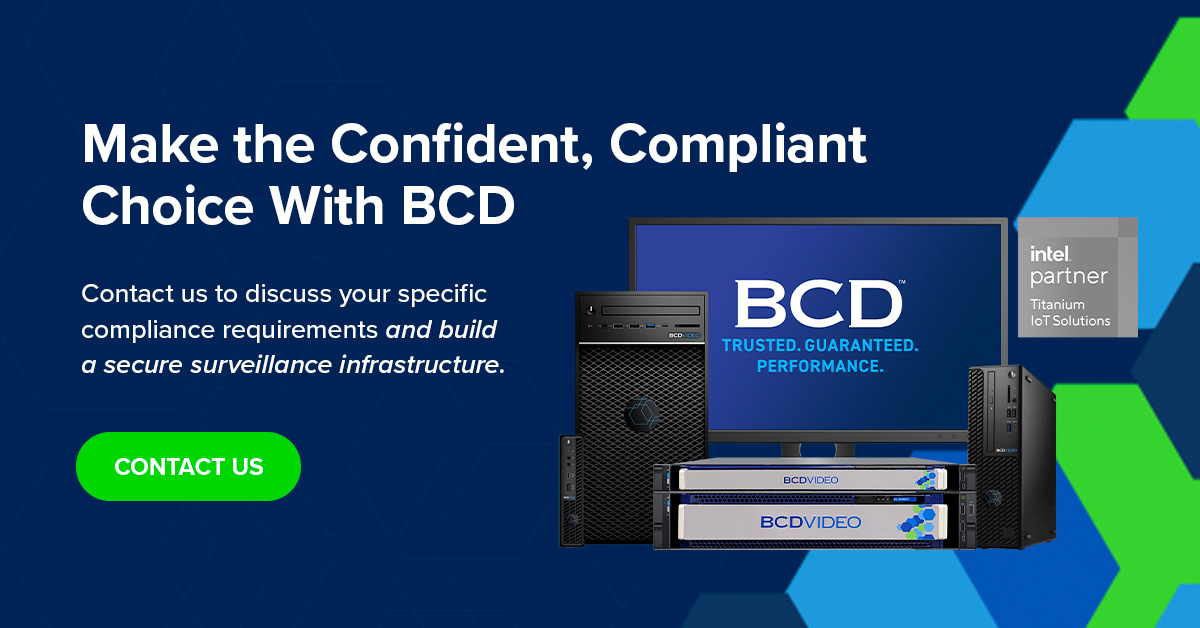
True compliance is a holistic commitment to supply chain integrity, deep cybersecurity expertise and proven partnerships. BCD embodies this approach, removing complexity and mitigating risk for government procurers through validated solutions backed by lifetime technical support. Our commitment to government security compliance ensures your agency maintains audit-ready documentation and meets evolving regulatory standards.
Our purpose-built surveillance appliances are designed with end-to-end supply chain transparency, validated by leading VMS manufacturers and supported by a partner ecosystem trusted by the world’s top security integrators. We provide the documentation and expertise you need to make audit-ready procurement decisions.
Contact us to discuss your specific compliance requirements and build a secure surveillance infrastructure.
Popular Posts


Confidence Built In
Choose Trusted Security Solutions From BCD
At BCD, we value all projects, no matter how big or small. We focus on providing purpose-driven solutions that make a difference to every security system. You can count on our extensive customer service to provide technical support whenever you need it — before, during and after the sale. Our support team will work with you to ensure seamless operation. Contact us online to discuss your next deployment.